
There has never been a more critical time for researchers to clearly and compellingly communicate the importance of their work to legislators, policymakers, potential collaborators, prospective funders, news outlets and the public at-large. Because effective communication to those outside your immediate field is fraught with challenges, UC San Diego’s Research Communications Program Team has been helping researchers at all stages of their careers reach their many important audiences since 2017.
UC San Diego’s Research Communications Program goes beyond one-size-fits all training. We offer customized options designed to meet each researcher's unique needs. The Research Communications Program Team is unusual in its breadth of expertise; we draw from theater, journalism, neuroscience, cognitive psychology and science education when designing workshops and providing researchers with critical feedback. The infographic provides an overview of our impact.

These achievements were made possible with generous support from the Gordon and Betty Moore Foundation from 2017-2025.
(Image downloadable as PDF)
Advance Your Career
Training sessions with the Research Communications Program Team have helped researchers win awards for their talks and posters. The sessions also give teams an edge when preparing for high-stakes conversations and presentations to potential funders.
Custom Workshops and Coaching for Individuals and Groups
The UC San Diego Research Communications Program can develop a tailored set of professional learning experiences for you, your research group, department or center.
We offer Zoom and in-person individual coaching sessions, research-group coaching sessions or workshops that can be adapted to meet the needs of your group.
In coaching sessions, the Research Communications Program team can provide feedback on your upcoming presentation or pitch or help you work on a specific skill such as:
- Responding concisely to interview questions
- Fielding challenging or controversial questions
- Vocal techniques to help you underscore your message
- Communicating the inspirations for your work
- Handling stage fright and building confidence
- Tailoring your website content for broader audiences
For workshop sessions, the size, length, format and topic can be tailored for you. Possible topics include designing visuals, selecting impactful language and avoiding hidden jargon, constructing narratives, vocal techniques to improve delivery, science advocacy and making the case to potential funders, on-camera interview practice, and more.
Please get in touch to discuss your goals. We can work with you to come up with a session or package that meets your needs and budget.


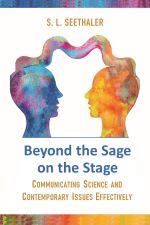 New Book on Research Communications by RCP Team Member
Beyond the Sage on the Stage: Communicating Science and Contemporary Issues Effectively by Sherry Seethaler has just been published and is available from the University of Toronto Press, Barnes and Noble and Amazon.
Drawing on an extensive research base that cuts across traditional disciplinary silos, Beyond the Sage on the Stage delivers evidence-based practical communication strategies and debunks often-repeated communication myths.
This book provides useful lessons for researchers, students, educators, medical professionals, journalists, policymakers, changemakers and anyone who wants to have more productive conversations about science, technology, health, the environment and the complex issues of our times. Topics explored include how to do the following:
- Detect your hidden jargon and select accessible language.
- Master the effective design of visuals and multimedia.
- Make astute use of metaphors and analogies.
- Structure explanations to support learning.
- Convey the humanity inherent in your work through story.
- Specify uncertainty meaningfully and with clarity.
- Provide adequate context to inform decision making.
- Address myths and misconceptions without backfires.
- Bridge ideological divides, cultivate empathy and build trust.
See also the review in Public Understanding of Science and The Medium, as well as the article in The Conversation.
Support the Research Communications Program
The Research Communications Program equips scientists to communicate their work clearly and effectively with non-technical audiences—from classrooms to policymakers to future partners. In today’s uncertain landscape for science, the ability to communicate clearly and compellingly is not optional—it is essential. Your support directly fuels workshops and trainings that equip scientists to share their discoveries in ways that inspire understanding, action, and real-world impact.
Sign Up
Please reach out to us (communicateresearch@ucsd.edu). Let us know what you would like to work on, so that we can assemble the right coaching team for your needs. If you would like to do a small group tailored workshop, please share your goals and the names of the colleagues or mentees who would participate.