Research Communications Program
- Researcher Supports
- Learning Library
- Communication Examples
- Career Paths
- Team
The research communications video library provides advice from diverse experts on how best to communicate your research to various audiences, in a range of contexts, using different kinds of tools. These videos are intended for faculty, postdoctoral fellows, staff and students who want to build their communication skills. The Research Communications Program takes a "modular" approach to its curriculum because what works best depends on both the communicator and the audience. Practice is key and even the most experienced communicators have something new to learn.
You can also download various tip sheets on the key topics covered. This course was designed by our partners at UC Berkeley.
Part 1- Why Explain Your Research and How To Reach Your Audience (video)
Part 2- Who Are Your Audiences? (video)
Part 3- Rearrange Your Story (video)
Part 4- Optimize Your Text (video)
Part 5- Use Visual Vernacular (video)
Part 6- Creating Images (video)
Part 7- Working With The Media (video)
This presentation video in five short parts teaches you when to reach out to your campus communication directors and how they can help you.
Presented by Dennis Meredith, author of Explaining Research
Sherry Seethaler presents research on perception and memory that provides an important foundation for thinking about how to design images and graphics to reach your intended audiences.
Gabi Schaffzin, an artist and graphic designer, provides practical tips on how to make graphs more informative and comprehensible for your audiences. Using a range of examples, he discusses the importance of making graphics glanceable and illustrates what features enhance glanceability.

Nick Spitzer discusses his experience explaining neuroscience research to broad audiences, and provides tips on how to use language and stories to engage people and provide insight into the scientific process.
Barbara Sawrey discusses how leadership communication fits within the scope of research communication, what are the particularly challenging aspects of leadership communication, and how to prepare for them.

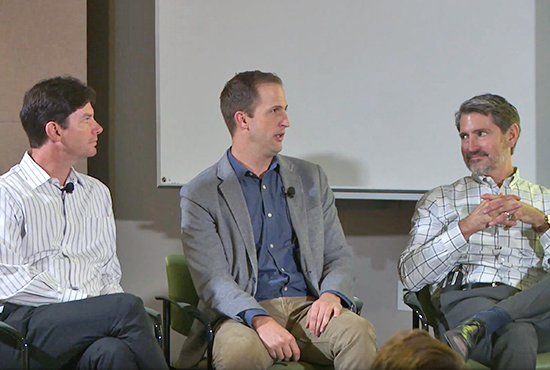
This panel discussion with Seth Cohen, David Puerta and Zachary Zimmerman, led by Sherry Seethaler, provides insight into the communication opportunities and hurdles on the way to gaining financial backing to turn basic research into a spinoff company.
In this presentation learn why social media is relevant to researchers and which of the common social media networks are most relevant for your work.

Why, what and how to communicate with a program officer or policymaker.
General differences between the state and federal level and state funding opportunities.
Overview of the UCSD Research Proposal Development Service for campus researchers.
Beyond the Sage on the Stage: Communicating Science and Contemporary Issues Effectively by Sherry Seethaler is available from the University of Toronto Press, Barnes and Noble and Amazon.
Drawing on an extensive research base that cuts across traditional disciplinary silos, Beyond the Sage on the Stage delivers evidence-based practical communication strategies and debunks often-repeated communication myths.
Topics explored include how to do the following:

This book is a comprehensive quide to communication for researchers, students, educators, medical professionals, journalists, policymakers, changemakers and anyone who wants to have more productive conversations about science, technology, health, the environment and the complex issues of our times. See also the review in Public Understanding of Science and The Medium, as well as the article in The Conversation.