Research Communications Program Team
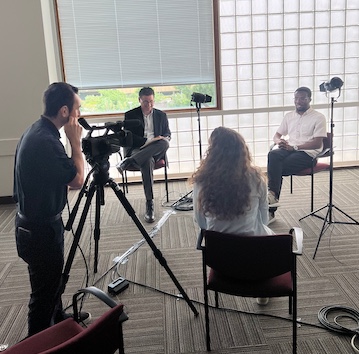 Unusual in its breadth of expertise, the Research Communications Program team draws from theater, journalism, science and science education when designing workshops and providing researchers with formative feedback. The team is also highly proactive in seeking synergies and collaborating with others.
Building on its extensive experience working with researchers across disciplines and at all stages of their careers, the team adapts and customizes trainings to meet researchers’ current needs and provides pathways to continued professional growth.
UC San Diego’s Research Communications Program has been helping researchers at all stages of their careers reach their many important audiences since 2017. Their professional influence extends well beyond UC San Diego.
Mario Aguilera
Mario Aguilera is Director of Communications for UC San Diego’s School of Biological Sciences, a position. His responsibilities include developing and coordinating communication strategies with leadership and publicizing research and scientific initiatives through news releases, articles, videos and social media. He also serves as co-leader of the campus’ Research Communications Program, which trains scientists to clearly and effectively communicate their research to public audiences.
Steven Briggs
Steven Briggs, Ph.D., is a professor in the School of Biological Sciences at UC San Diego. As an advisor to the RCP team, he also brings extensive industry experience including as President of Torrey Mesa Research Institute and Senior Vice President for Corporate Research at Diversa. He is a member of the National Academy of Sciences, and a Fellow of the American Association for the Advancement of Science and the National Academy of Inventors.
Debbie Nail Meyer
Debbie Nail Meyer, M.S., is a science communicator and technologist with a background in ocean research. An alumna of Scripps Institution of Oceanography, she has supported science outreach for UC San Diego and private research organizations through her multimedia work with news media, documentary television, YouTube production, and ship-based fieldwork, translating complex science into accessible, engaging stories.
Kim Rubinstein
Kim Rubinstein, Ph.D., UC San Diego Professor Emerita, Theatre/Dance Department. Nationally recognized as a Master teacher of acting and an award-winning director. Other teaching credits: Northwestern University, University of Chicago, Brown/Trinity Consortium, Wesleyan University, The O'Neill Center, School at Steppenwolf. Professor Rubinstein has done extensive research on the creative brain culminating The Creative Mind Lab that offers workshops combining neuroscience with theatre techniques towards optimal creative productivity.
Sherry Seethaler
Sherry Seethaler, Ph.D., is the author of Beyond the Sage on the Stage (University of Toronto Press, 2024), an evidence-based guide to effective communication. She has led a variety of education initiatives at UC San Diego and was the “Science Questions Answered” columnist for the San Diego Union-Tribune. Her books Lies, Damned Lies and Science: How to Sort Through the Noise Around Global Warming, the Latest Health Claims, and Other Scientific Controversies (FT Press) and Curious Folks Ask 1 & 2 (FT Press), have been translated into several languages. Seethaler has degrees in the physical sciences, life sciences and social sciences.
Professional Influence
Faculty have applied what they have learned in Research Communications workshops and coaching to reach a wide variety of audiences, and the program’s professional influence goes well beyond the researchers in its workshops. Team members have presented at national and international conferences and have published articles, as well as a peer-reviewed book, to disseminate the work to scientists and science communication trainers.
Example publications include:
- Article in The Conversation
- Paper in Science Communication
- Paper in The Mathematical Intelligencer
- Book Beyond the Sage on the Stage
- Book review in Public Understanding of Science
 Image is downloadable as a PDF.
Support the Research Communications Program
The Research Communications Program equips scientists to communicate their work clearly and effectively with non-technical audiences—from classrooms to policymakers to future partners. In today’s uncertain landscape for science, the ability to communicate clearly and compellingly is not optional—it is essential. Your support directly fuels workshops and trainings that equip scientists to share their discoveries in ways that inspire understanding, action, and real-world impact.